Tuesday, May 14, 2013

Spock, artificial intelligence, and thievery


So with the incoming release of Star Trek: Into Darkness I found myself wondering why I was compelled to see it. Then it hit me, Spock. There isn’t anything else which is appealing to me about the many explosions, pretty men, or even Spock himself. It is the concept of Spock’s character alone. Now I’m no Star Wars fanatic so you won’t find me giving a description of Spock’s background, as a Valcon or is it a Falcon? Atlanta Falcon? Did Spock play Football?
Anyways, what greatly interests me in the concept of Spock is that he was created to be a completely logical being. Super and artificial intelligence is the recurring factor in many great Sci-Fi movies: Alien, 2001: A Space Odyssey, Moon, and last and probably least, to twist the common platitude, Prometheus; all different forms of unbalanced or carefully crafted intellect. You may think artificial intelligence greatly varies from pure-logic, but pure-logic is and should be the blueprint for all artificial intelligence because most, believe it or not(if you possess the human faculty of belief), like to avoid co-existence with an illogical being.

What is so interesting about these intellectual hybrids is their contrast to their human counterparts. If a man steals another man's space wallet(possibly embroidered with Marvin the Martian) aboard the Starship Enterprise a common man feels sympathy or anger, but if you're Spock, you understand that man may be hungry, forget his own space-wallet, and of course that money buys food. Spock wouldn’t particularly feel sorry for the thieved, but would likely find the offender to be in what the human race considers a more pitiful position; following a quick, practiced flow of deductive logic.

Now a.i. tends to be more dangerous in movies. It doesn’t first consider logic and then balance their individual beliefs, they don’t have empathy and one would imagine, see everything in existence as data. A.i appears to threaten humanity more than a figure like Spock, but then again, it is arguable that a.i. may not be superior to humanity, while a being which possesses all that is human with a capacity for logic beyond us pitiful bipeds, would truly be superior.

Would any of the movies listed above have nearly as much magic without these creations, would a man’s fear be as fearful to us if he weren’t standing near a creation who doesn’t understand fear. Would you constantly question what the exceptional creation was contemplating or processing at each scene if a figure was simply taller than his surrounding characters, as opposed to possessing a different breed of intellect? What is so mesmerizing about these simple yet complex creations? “What is it Dave?”

Monday, May 13, 2013

Revisiting Anton Chekhov

So, this week I've been reading Anton Chekhov, who I've read in past and felt a need to revisit. The book is a Dover Thrift Edition which is titled "Anton Chekhov- Five Great Short Stories." It was borrowed to me and quickly read.

Dover Thrift Edition books, if you're not familiar with them, have unique, often psychedelic designs around the entire book as well as a very bold and concise summary of its content on the back-cover. The first story I read from this series was Dostoevsky's Notes from the Underground, translated by Constance Garnet. So naturally and nostalgically I was looking forward to a Chekhov refresher in the is particular format. This book, as well as Dostoevsky’s Notes from the Underground, were originally priced by Dover at $1.00; which makes one familiar with Russian Literature immediately realize great literature was and still is available at a negligible price… the thoughts and inspiration you can obtain for say $50 is a scary thought, when conventionally one often pays $50,000 for an education they’re not disposed to retain, value or appreciate. But then again, thinking differently can be dangerous as learned below.

Anyways, the book was more than I expected. I borrowed the book because the concept and commonly interpreted themes of one of the stories included in the collection, called the Black Monk interested me greatly, and to keep this blog under 46 pages, I’ll just partially touch on this story alone, although the other’s in this collection aren’t lacking in substance.

The Black Monk is a story about a man named Korvin, who is dubbed or possibly officially titled: “The Master of Arts” (what a title) who due to sickness moves back to the land of his childhood to get well by escaping all the possible un-pleasantries in Moscow. The story has a heartrending subplot, but I will only touch on the title character, the Black Monk, who appears to Korvin shortly after his visit to what one may call his homeland.

The Black Monk is a mythical figure who is known to be seen in visions precisely every 1000 years. Korvin is fortunate to see the Black Monk who tells him he is destined for greatness, which inspires him to work (study and write), while all the while a marriage is made between Korvin and the self-righteous gardener’s daughter. This vision of the Black Monk leaves Korvin and his acquaintances questioning the balance and importance of sanity, love and greatness. It causes Korvin to frown in the direction of what he believes is the common or the inconsequential beings as gardeners or clerks, while love and the fear of being perceived as insane diminish or devalue the want for greatness the Black Monk foresees as inevitable. The illusion gives him insight to his curse of genius and all the while ruins him physically and mentally. The story delivers a tragic ending and causes you to question what Korvin and his acquaintances are cursed to question long after the short story is finished.

I was going to include a Black Monk Inspired Knock Knock Joke to lighten the air, but after reading the joke I realized no one should be submitted to my humor... guess I'll just leave you thoughtful, sad and hopefully curious...
"What does it all mean?"

Sunday, May 5, 2013

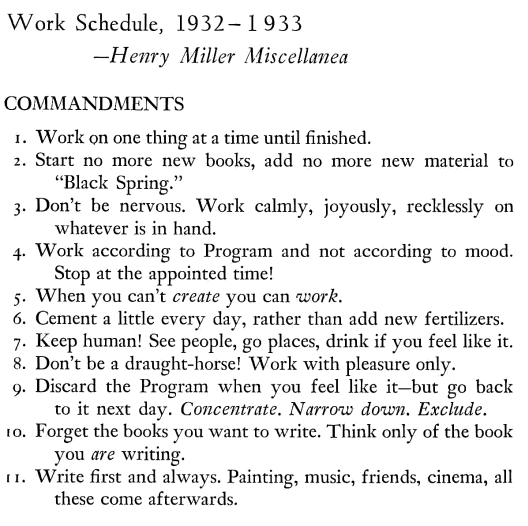
Henry Miller's 11 commandments, of course there wouldn't be just 10...


I first began reading Henry Miller 5 years ago. His work was borrowed to me by my current girlfriend, early into our relationship, and I was nothing short of obsessed with his style. The first book of his which I read was Tropic of Cancer. It was published in Paris in 1934 and banned in America until the early 1960s. I wasn’t particularly interested in literature, let alone exposing myself to it until this book. The work was a undiluted exploration, as was it fitting to the moment I read it, considering it was Henry Miller finding and learning himself as a writer and some may say man.
TropicOfCancer.JPG

I've read the commandments atop this post over the years while reading about Miller and his history. Number “3.” and “8.” Are my personal favorites and of course Miller’s list of commandment’s would include 11 commandments as opposed to the traditional, or some may say original 10, because Miller was a man of excess, as Jesus and his holy receptor Moses weren't known to be.

Miller’s prose has no equal, and cannot be replicated. It knows no rules, and laughs outside of the boundaries. It doesn't worship the petty, but will play with it for the amusement.

If you survived reading his commandments, and were by any means interested by this post, feel free to be amused by the video below. Somehow, to our worldly pleasure, a man of his brilliance, passion and strangeness existed while camcorders were owned. 

Thursday, May 2, 2013

Inherent Vice

As was announced yesterday, Thomas Pynchon's novel Inherent Vice, is scheduled to be adapted to film by Paul Thomas Anderson in partnership with Warner Bros. This recent Warner Bros. announcement is being compared to Kubrick's past collaboration with the exceptionally large studio, which will undoubtedly result in a much larger audience for Anderson. This announcement reminds me of the scene in a movie named Synecdoche, New York (which coincidentally stars one of Anderson's regularly cast actors) where Phillip Seymour Hoffman's character is granted what seems to be a multi-million dollar grant solely to promote and motivate his genius which would in turn be expected to benefit those who would is result, observe the creation. Then again, this could cause PTA to create what he feels would be a blockbuster which could be disastrous to all involved, but hey now, aren't all PTA fans too optimistic to consider the latter result, the answer is no, not likely, for we may enjoy PTA's There will be Blood solely due to the scarring cynicism.

I personally feel PTA will not sacrifice his integrity to be associated with Warner Bros. and likely persuaded the giant with Master inspired dianetics, to throw bags of money at his backside to propel his unique whims of self expression. Inherent Vice will take longer than expected to create. PTA will not compromise, which is already evident, considering he told Robert Downey Jr. he was too old for the starring role. Poor Iron Man... See you in the theater.